Friday, April 17, 2020


From our new anchorage spot at Miami’s Marine Stadium we had a different view of the city’s night  skyline.  This is looking across Biscayne Bay at the southern part of the city near the Miami River.  The Rickenbacker Causeway is just out of sight to the left.

When we arrived at Elliott Key there were only a few boats.  When the weekend crowds came that changed.  The early morning stillness did not last into the day.

Back at the Marine Stadium you can see Miami in daylight.  Over toward the right is a small island with a sand beach.  It is much closer to us than the city.  This was the scene of a back and forth, cat and mouse game between the people who came to play on the beach and the Miami Police who were enforcing the mayor’s beach closure order.  While the police had helicopters and high speed boats, it was not quite as exciting as Miami Vice.

Protected by his hand sewn mask and rubber gloves and with a pocket full of wipes saved from Publix weeks before,  Bill returns in the dinghy with 30 gallons of water, 15 gallons of diesel fuel, and a gallon of gasoline to fill our tanks for the start of our journey north.


I baked us a loaf of bread saving us a trip to the store. 


Spring is on its way, and we are on our way home.

When I last wrote, we were anchored in Miami Beach and planned to go to the Florida Keys, around to the west coast of Florida, then back to the Florida east coast by passing through the Okeechobee Waterway.  Well, as soon as we were ready to leave, the roads into the Keys were closed to all but residents.  Just to make it obvious that we weren’t wanted, Monroe County closed the bars, restaurants, marinas, beaches, and parks.  Key West even closed the sunset.  Bill and I took the hint and decided not to go there.  Our earlier decision not to go to the Bahamas turned out to be most fortunate.  The Bahamian restrictions on cruisers have gradually become increasingly severe.  Currently, not only are foreign boats prohibited from entering the Bahamas for any reason, but if already there they must stay in a single place, they cannot travel from one island to another, they must register with the national government, and they cannot go ashore.  All foreign boats are encouraged to leave as soon as it can safely be done.  Foreigners must seek medical aid in their home country, not in the Bahamas.  I am glad we did not go.

Even in Miami Beach the things we usually enjoyed doing either were closed or prohibited by Emergency Orders.  I thought it unwise for us to even go ashore to walk around because we were both 69 years old and Dade County was the Florida virus hotspot.  With little to do, we decided we needed a change of scenery and motored south about 5 miles to anchor in the Marine Stadium at Virginia Key.  This anchorage gave us a different view of the Miami skyline.  The state, county, and city Emergency Orders that were designed to discourage boating seemed to have little effect in the Marine Stadium.  Every afternoon motorboats and jet skis whizzed around with loud Latin music.  One morning when it was still quiet and calm, Bill said, “I think I’ll take the engine apart today.”  I was horrified and talked him out of that project.  Instead of taking apart the engine, he took apart the toilet, the only other necessary part of the boat, to repair a valve which had been leaking seawater into the bowl.  He stopped the leak and got the toilet back together before I needed it.  Whew.  Later, he did take the engine apart; well, not really.  He took the rocker arm cover off and adjusted the valve clearances.  Our little diesel was suddenly much quieter.

After being at the Marine Stadium for a couple of days, we decided to go a little farther south to Elliott Key.  Elliott Key is the most northern of the Florida Keys and is part of the Biscayne Bay National Park.  All the shore side facilities at the park were closed, but it would be a change of scenery.  We spent the weekend anchored with about fifty other boats.  It was a hang out and party spot for local boats providing small sand beaches for lounging and a dock that gave access to trails on the island. Folks took their dinghies to the beaches, set up umbrellas, laid out on beach towels, and waded in the water.   One large boat tied up to the dock and the crew went inland.  It was not long before a police helicopter repeatedly swooped above the crowd with flashing blue lights, a siren, and a loudspeaker telling people that the beach and dock were closed, and that everyone must leave.  The next morning a police boat came and strung yellow tape along both sides of the dock.  The foiled beach parties resumed on several boats and continued all weekend.  Binoculars made the anchorage a great people watching spot. 

A coming west wind would make our Elliott Key anchorage uncomfortable, so we moved back to the Marine Stadium.  A small island with a white sand beach was behind us.  Like all public and private beaches in Dade County, the beach was “closed”.  That had no effect on the people in motorboats who would anchor just off the island then go to the beach.  We watched the periodic arrival of Miami police by helicopter or boat, the evacuation of everyone from the beach, the departure of the police, and the return of the people to the beach.  It was like watching a basketball game where two evenly matched teams alternate scoring with neither gaining an advantage.  We cheered for both sides.  Even encircling the island with yellow police tape failed to upset the balance in the game. 

Tiring of the unresolved skirmishing for the island and the co-current nearby battle of competing boat stereo systems, we returned to my favorite, quiet, and uncrowded Miami Beach spot between the Julia Tuttle Causeway and the Sunset Isles.  We just hung out on Irish Eyes reading, knitting, occasionally watching a movie, and listening to the Sirius radio work its way through the top 1000 classic rock songs, top 1000 classic pop sounds….  It was time to go.
 
It was mandatory to wear a mask in Miami Beach, so Bill sewed himself a mask out of a blue car washing towel.  Masked and gloved, he took the dinghy and returned with fuel and water to fill our tanks.  There was plenty of food on the boat, so we skipped a trip to the grocery store.  We put the dinghy on the deck, cleaned a month’s worth of marine growth off its bottom, folded it away, and left Miami.  There were small craft warnings offshore, so we motored north in the ICW through all the bridges.  There was little boat traffic until we got to Fort Lauderdale where the traffic picked up dying away again past the St Lucie Inlet. 

Tonight, we are anchored for our second night in Fort Pierce waiting for the wind and rain to leave before we do.  Back when we planned to go to the Bahamas, I sent all my warm clothes to our daughter Julia.  I have a pair of capri length pants, one three quarter length sleeved shirt, and a sweatshirt.  I also have a pair of socks because I knitted them.  We’ll travel north slowly to be sure that spring stays ahead of us going no farther north than the tee shirt weather.  We are headed back to New Bern then home to Kingsport.
 
Hope to see you distantly soon.  Stay at home, it’s the only safe place.

Friday, March 20, 2020


The Southport storm put almost 4” of water in our rain gauge.  Traveling on the Waccamaw River between Myrtle Beach and Georgetown, we could see its effects.  The river was out of its banks and flowing fast.  This house had the water up to its doorstep; others were worse.  We normally motor at about 5.5 knots.  That is how fast we travel through the water.  But here, the water is moving in the same direction that we are moving, so together we are making over 8 knots.

Just south of Beaufort, SC we ran into fog.  Hidden behind the haze were a pair of nearby highway bridges, and a park like shoreline, and the naval hospital.  Like you, all we could see was fog and our lifeline.


In Georgia this huge collection of tugs, dredges, barges, and floating dredge pipe met us.  They were going north.  We moved way over to the side to let them past.

The 656-foot-long car transporting ship, Golden Ray, rolled over on its side last September as it was leaving Brunswick, Georgia.  It had 4300 cars still on board.  They will soon begin slicing it into eight pieces to get it out of the channel.  You are looking at its bottom.  This was as close as we could come to it.

In Port Everglades I saw this cargo ship with a sailboat perched on its foredeck.  I wonder where it is going.


A motor yacht came and anchored behind us for a few days.  It had the little umbrella on its bow.  I had a similar umbrella on my drink.

This 200+ foot long motor yacht is docked east of us.  Like most large (and some not so large) yachts, it does not fly an American flag.  The flag you see is the Marshall Islands.  That is in the middle of the Pacific Ocean.  I doubt that it has ever even been there.  Its name is Utopia IV, and Google can tell you more.

To our west is the Miami skyline.  We get this view every evening.  Nice, isn't it?


Hello from sunny and warm Miami Beach.  I hope you are all well and polishing your newly learned Social Distancing Skills.  On our floating home Bill and I are definitely good at Social Distancing.  We are 200+ yards away from any land or other boat and farther still from any person.

After all our mechanical troubles were resolved, our trip south was relatively easy.  It was cold, but it was not nearly as cold as in past years.  To stay warm outside, I never had to wear two pairs of wool long underwear or two pairs of socks.  We navigated the shallow ICW trouble spots without incident due to luck with the tides, recent dredging, and river flooding.  Against my long-held opinion that travelling on the ICW in the dark was not a good idea, we did do a short trip in the dark.  After going through the Wappoo Creek Bridge, south of Charleston at 3pm, we agreed it was too early to stop for the night.  I asked Bill if he had a place picked to anchor before dark.  “Of course, there is a perfect spot”, was the reply.  Well, the guidebook said the spot had room for two boats.  When we got there, exactly two boats were anchored in our spot.  There was nothing to do but to push on.  The sun went down, and we motored in the dark for about an hour before arriving at Church Creek on Johns Island.  My opinion proved correct; navigating the ICW in the dark proved both scary and dumb.  Even with our radar and GPS, all around us were the lurking beasts and terrors that we could not see.

In the morning a few days later in Beaufort, SC, it was cloudy, and rain was predicted to begin in the afternoon.  We raised the anchor just after sunrise and headed south.  Only thirty minutes into the trip, fog descended.  I mean thick, dense fog that obscured anything not on the boat.  We managed to creep over close to the shore without hitting it and dropped the anchor.  The fog lifted a couple of hours later, and we were on our way.

I think our coldest day was February 29th.  Well, the temperature may not have been the coldest, but the wind was blowing at a steady 25 knots which made it feel cold.  We were crossing St. Andrew’s Sound between Jekyll Island and Cumberland Island.  The wind was on our nose, and waves were breaking over the bow of the boat.  In addition to my worries about the weather, we motored past some folks in kayaks who were paddling across St. Andrews Sound.  Both Bill and I remarked that they should not have been out there.  Hours later we heard them call the Coast Guard.  A 53-year-old woman was missing.  A helicopter and boat were dispatched for the search.  Long story short, they found the yellow kayak pulled up on shore at Cumberland Island with footprints in the sand, but we never learned the rest of the story.

Once past Cumberland Island we were in Florida!  Each day was warmer than the one before.  A stop in Vero Beach was in our plans.  Bill had ordered a cell phone booster and some other stuff from Amazon.  I had ordered some knitting needles and a pair of shoes.  All would be delivered to the Vero Beach City Marina.  It was also time to shop for a few groceries, have an unlimited hot water shower, and get off the boat.  We had on board an antique double barrel shotgun that last belonged to Bill’s deceased stepmother.  Bill’s step nephew Cyrus, who lives in Stuart, wanted the gun.  He came to Vero Beach, we gave him the gun, then we all had a lovely restaurant meal and visit.  My missions in Vero Beach were accomplished: I had my new shoes and knitting needles, and the shotgun was off the boat.

Corona Virus began to fill the evening radio news.  We continued south.  The two-day trip through Palm Beach and Ft. Lauderdale to Miami was trying.  There were 27 bridges that had to open for us.  Most had a fixed schedule, and we were forced to wait at those bridges for a scheduled opening.  All went well until we arrived at the Fourteenth Street Bridge in Pompano Beach.  It was broken, could not open, and took two hours to repair.  We were the first boat at the bridge, but there was a long line of boats assembled behind us.  When the bridge finally did open, the parade began.  We were slow, and the others were faster.  As we went from one bridge to the next, first one, then another, and finally all the other boats overtook us, but we were always in the parade.  The faster boats got to each bridge at its scheduled opening time, and the bridge stayed open until the whole parade had passed through.  That way we got all the way through Ft Lauderdale without waiting on a single bridge.  It was a record for us.  

We were in Sunny Isles Beach when the sun began to set.  A right turn, a trip down a long canal, and we were anchored in Lake Maule for a peaceful and quiet night.  It rained a little in the morning, and after the showers moved away, we left for Miami.  Bill was on the bow putting away the anchor and cleaning up the deck when I tried to leave the lake by the wrong canal.  The one I entered was a narrow dead end canal with boats docked on both sides.  There was no way to turn around.  Panic!  Bill took over, revved the engine in reverse, straightened the boat out, and backed us out of the canal as the neighborhood dogs barked their heads off.  Whew.  It was not a good way to start the day.

Three more bridges opened for us, and we dropped our anchor here in Miami Beach south of the Julia Tuttle Causeway just after noon on March 12.  It was our latest arrival in Miami Beach.  The Corona Virus news continued to get worse.  The Mayor of Miami Beach told the Spring Breakers, “Go home.  The party is over”.  The crowd started thinning.  The next day Bill got a prescription refilled and picked up an Amazon package from an Amazon Locker.  I got a haircut.  The guy who cut my hair was very pleased with his work.  Me, not so much.  My hair was left shorter than Bill’s.  Oh well, I will not have to have another haircut for quite a while.

On Saturday we went to Lincoln Road, a popular Miami Beach pedestrian outdoor mall, and stopped at our usual pizza place.  At 1pm only two of their thirty or so outside tables were occupied, and we were one of them.  The promenading crowds that we love to watch and comment on were sparse to say the least.  That afternoon all restaurants and bars with occupancy of 250 or more were ordered closed, and the others were reduced to half their licensed capacity.  Later, all the restaurants were made take-out or delivery only.  First, much of the beach was closed, then all the beach was closed.  At Publix on Tuesday. there were a few packages of fresh beef but not any chicken or pork.  The egg shelf was bare, and rice and pasta were rationed.  There were no paper products, no Clorox, no hand wipes, no flour, and no bottled water.  At the laundromat Wednesday rules were posted --- one person per family in the establishment at a time, put your clothes in the washer and then wait outside, put the clothes in the dryer and wait outside, no folding allowed in the store, and keep away from other people.  We obeyed the rules.  The crowds were gone.  The street traffic was light.  By Wednesday our necessary onshore chores were completed.  The boat is now stocked.  Except for a fuel and water run, we do not plan to go back into town.

With all the concern about Corona Virus, Bill and I have decided to make this year’s trip, ‘Irish Eyes to Florida’.  We are worried we could leave for the Bahamas and be refused entry.  We are also worried that if we left we might not be able to get back into the US.  The areas we like to visit in the Bahamas lack medical services.  Most of the food in the Bahamian stores there comes from the US.  I am sure the shipments will soon become slim.  I do not need to eat their food.  Instead of going the Bahamas, we are going to go south through the Keys, around the bottom of Florida, up the west coast, and return via the Okeechobee Canal.  There are lots of places to anchor with no shore access.  That is fine.  Bill can work on his boat projects, and I can knit while we watch the sunsets from our cockpit alone.  We have plenty of food and toilet paper, gin and tonic water.  We’re all set.

Stay well and safe.  We’ll try to do the same.

Sunday, February 23, 2020


While stopped in Wilmington, we walked around town.  Passing by this house Bill pronounced it the home of his great aunt Neely.  Now, he was only there once, and that was in about 1970.  When pressed, he says that it looks like the right house anyway.

We had the boat hauled out in Southport, N.C. for repairs hoping to stop a loud squealing noise that was coming from her engine.  Here she is, all 13,500 lb resting on her keel and propped up with these flimsy jack stands.  That is were we were sleeping (or not sleeping) during the night of the storm.

In the previous photo you can see the metal steps leading up to the cockpit of our boat.  I thought you would enjoy a close-up view.  While they were a great improvement over the usual 12 ft stepladder, they still left much to be desired.

After they made us leave the boat for our safety and while the wind was still howling, we walked into town and had a nice breakfast in this restaurant.  The hair of the woman in the picture looked as bad as mine did.  Bill, without much hair, had less of a problem.

The storm blew down this 100 ft tall, 100-year-old signal flag tower in town.  It was used to display storm and hurricane warning flags.  It had weathered every wind until our storm came along.

Four motorboats on the top tier of the dry stack racks near our boat blew off their wooden bunks in the storm.  They did not fall to the ground, but they ended up resting on the steel framework.  It took a crane to get them down.  You can see it in the picture.

While the crane was working, the yard crew launched Irish Eyes with her new propeller shaft and Cutless bearing.

In a second attempt to fix the noise, a diver was called to remove our propeller and install our spare.  You can just see his feet as he worked head down in the cold water.  The spare propeller and his tools were on the dock.

We are now finally underway again and headed south.  This is the 13th time Bill and I have taken Irish Eyes south to the Bahamas.  If I were a superstitious person, I would be really worried about this trip because we have already had a bucket load of troubles.  But, I am getting ahead of myself, so I will back up and start at the beginning.

On January 11 Bill and I packed lots of clothes, three seasons worth, and anything else we thought we might need into our car and headed to New Bern, NC.  The driving trip was uneventful, and we were happy to be back on Irish Eyes.  Bill had a list of boat projects to complete before we could leave the dock.  The biggest one was installing a complete AIS system on our boat.  AIS stands for “Automatic Identification System”.  It broadcasts our name, position, and course so other boats can tell where we are going.  Up to now, we have been able to receive information from other boats but had not been able to broadcast our own information.  I like this addition.  I have never been sure that anyone looking down from a big ship and could see little us.  Now, we will show up on a screen on their bridge.

The morning after we arrived in New Bern, Bill started the engine and noticed a leak from the fuel injection pump.  We had a leak there last summer making our trip home a little scary.  Bill had replaced an o-ring during the summer fixing that leak, but this leak was another spot.  There was a mechanic working on a boat across the dock from us.  Bill asked him if he would come and look at our pump.  The mechanic came, looked at it, and said, “Call Troy at Coastal Diesel Service”.  Bill knew another mechanic.  He came out the next morning.  He said the pump needed to be fixed, and he said, “Call Troy.”  Bill called Troy.  Two weeks later the pump was fixed and back on the boat.  During that time Bill was busy with things on his boat to-do list, and I was busy with my knitting and reading.  As soon as the injection pump was installed, I bought the fresh food, Bill filled the car with everything we wanted to leave behind, he parked the car in the long term lot, and we were ready to go.

On January 30 at 9:30 in the morning, we untied the dock lines and headed out.  As we were motoring away from the dock both of us heard a squealing or singing noise as the engine passed through 1500 rpm, but it stopped and neither of us thought that it was a problem.  We motorsailed to our usual first night out anchorage in Cedar Creek where we had a quiet and peaceful night.

But, the noise remained.  Between 1300 and 1700 rpm there was an unmistakable monotone scream from somewhere around the engine.  Bill thought the nut on the packing gland was rubbing on the propeller shaft.  Neither greasing the nut nor re-packing the gland fixed the problem.  After four days of listening to an unhappy boat, we went up the Cape Fear River to the Wilmington City Docks.  There we could try and find the source of the noise with the boat stationary, and there we would be near boatyards with expert mechanics.  Once we were tied to the dock, we tried to reproduce the scream, but the noise was not there.  What was up?  I googled the problem and told Bill my findings, perhaps a loose alternator belt, a worn alternator, a faulty Cutless bearing, or maybe a bad shaft.  Bill found the alternator belt loose, tightened it, and pronounced the problem fixed.  Elated, Bill and I played tourists in Wilmington enjoying lovely warm weather, restaurant meals, and a railway museum tour.

As soon as we untied from Wilmington City Docks, we could hear the 1300 to 1700 rpm scream.  Bummer.  Bill called Wilmington Boat Works, and we went there to have a mechanic look at our engine.  A mechanic came and decided we needed to have the boat hauled out of the water and the shaft and Cutless bearing replaced.  There was just one small problem.  The yard was having concrete poured the next morning, and they said it would be three weeks before it would be hard enough to put us back in the water.  The yard guys suggested we go to Zimmerman Marine in Southport.  That is what we did.

Zimmerman’s mechanic, Steve, went for a short ride with us, listened to the noise, and recommended that we have the boat hauled out so that the shaft and Cutless bearing could be examined.  We said okay, they plucked the boat out of the water, propped it up on jack stands in their yard, and set to work.  They gave us a set of twelve foot tall metal steps to come and go from our stranded home.  This was February 5th, Bill’s 69th birthday.  Happy Birthday, Bill.

An old friend of ours from Salisbury, George Wilson, lives on Oak Island.  George came over to Southport to visit.  Bill and George traded stories for an hour or two, then we all went out to lunch.  Back at the yard they condemned the shaft and Cutless bearing.  A new bearing was ordered from Norfolk, and a new shaft was to be made by a Wilmington machine shop.  It looked like it would be a short repair process.

The next night a cold front passed through Southport.  The wind howled, gusting to 80mph, lightning flashed, and the rain poured.  Our boat on jack stands swayed in the wind.  In my mind the boat was threatening to fall over any minute.  I did not sleep much.  At about 6:30am we heard some knocks on the hull and a voice saying, “You have to get off the boat right now.  It is unsafe.”  Bill and I dressed quickly and left the boat.  The wind had unfurled the sail on another boat in the yard, and the yard master was afraid that boat would blow over toppling us and the other boats like a line of dominos.  In addition, four motorboats on the top level of the dry stack storage were blown off their supports.  They did not fall to the ground but were just sort of hanging there.  The wind was still howling, the place was unsafe, and all the workers were sent home.  This was Friday.  No work was going to be done on Irish Eyes until Monday.  Another bummer.

Bill and I walked into town.  I had the clothes on my back, my phone, no makeup, and unbrushed hair.  I felt, and looked, like a homeless person.  We had a gourmet breakfast, spent two hours touring a one room museum, and gawked at the 100-year-old hurricane warning flagpole that the winds had destroyed while a TV news crew interviewed the police chief and mayor.  We then went back to the boat yard to see what was happening.  The yard master said we could not stay on the boat until a crane could come and remove the four motorboats.  He did let us go back on Irish Eyes and get our things.  Bill and I walked back into town carrying our belongings in the two tote bags we had with us and checked into the Inn at River Oaks.  The Inn is a 1950s motel which has been refurbished and is lovely.  We spent three nights sleeping in a stationary bed.

Monday morning, Bill walked back to the yard to see what was up.  The workers said the crane would be there Tuesday.  Bill really wanted to be back on Irish Eyes and convinced the maintenance manager to say we could move back aboard so long as we kept a low profile.  So, even though the motorboats had not yet been removed, we moved back on our boat.  Work continued on Irish Eyes.

On Tuesday as a crane was lifting the motorboats off the dry stack’s steel racks, the Travelift launched our boat.  Bill, Steve, and I went for a ride.  The noise was still there.  The shaft and cutlass bearing were new.  Where was this noise coming from?  In desperation engine oil and the transmission fluid samples were taken and sent away for analysis.  Bill replaced our alternator and two vee belts in case that was the problem.  Then, to add to our woes, our hot water heater suddenly ruptured spilling water into our battery box.  Bill mopped up the mess and ordered a new water heater.  Friday, Nick, an engine specialist, went for a ride with us, and he said he thought the scream was coming from our propeller.  Friday night as the sun was setting, a diver came and replaced our propeller with our spare propeller.  (Bill of course had a spare).  Our replacement water heater had arrived, so Bill had something to do over the weekend while the yard was closed.  Sunday, Bill and I took the boat for a spin.  The scream was at last gone.  We needed to have the engine aligned, and we needed to pay for all the work.

It took two days for Steve to align the engine with Bill’s “help”.  They had problems with the engine mounts, but finally on Thursday they were both satisfied.  Another cold front was coming, and snow was predicted.  The wind picked up on Friday, it was very cold, the marina closed because of the weather, but there was no snow.  After two and a half weeks repairing the boat, we untied our dock lines on Saturday and left.  It is great to be on the move again.

Stay well and warm.

Monday, June 17, 2019


Everything in the Bahamas is expensive.  This box of crackers was $8.


Bill’s black eye was quite impressive although he said that it did not hurt.


When we woke up at Mile Hammock Bay, it was raining.  Rather than leaving in the rain, Bill made these cinnamon pecan pinwheels for our breakfast.


Greetings from our land home in Kingsport, Tennessee.  Bill and I arrived here Friday night, June 14.  Our land house seems to have fared okay without us, but I now have lots of projects here on my to-do list. 

Now, back to the description of our trip.

We left Brunswick, Georgia after breakfast on June 5.  The dredged channel from the harbor out to deep water in the Atlantic was long.  The shallow water along the Georgia coast extends miles out into the sea.  I felt like it took us hours and hours to finally reach the point where we could turn and head north.  Bill told me it was just two hours, but it was the sort of two long boring hours that seem like ten.  We motor sailed along the Georgia coast most of the day, but the wind picked up in the late afternoon, and we sailed on, flying both headsails and with one reef in the mainsail.

Just as it was getting dark, it began to drizzle rain.  The wind went behind us, and the sea was sloppy making the mainsail bang about.  Bill went forward to put a preventer on the boom, and somehow, he got hit in the face by a flapping genoa sheet.  His left eye was immediately bruised, swollen, and black.  Somehow, he did not lose his glasses overboard, but they were very bent.  I had been thinking we had been extremely lucky… with all the broken things on Irish Eyes, neither of us had been injured.  That thought came to a sudden end as Bill lay below on the settee with an ice pack on his injured eye.

We sailed or motored the rest of Wednesday.  Around Savannah, we had to dodge some ships, but nothing too exciting happened.  Wednesday turned to Thursday as we continued our trip staying 50 miles or so off the Carolina coast.  Bill was the chef on this part of our cruise.  The first night he made biscuits for country ham biscuits, and the second night he made individual meatball pastry pies.  I think he was bored and hungry on his watches and was dreaming up ways to use the remains of our food.

Finally, after almost forty-eight hours underway, we entered the Cape Fear River as the sun rose.  I was hoping we would stop at Carolina Beach, anchor there, and have a nice long nap.  No, that was not to be.  The captain went right past Carolina Beach and continued up the ICW heading to Mile Hammock Bay.  It is sixty miles from the Cape Fear River to Mile Hammock Bay.  That maded for an all-day trip.  A half mile before our destination, we crossed the New River as it flowed to the sea.  The crossing was an “ICW trouble spot”.  It was very shallow, and the printed charts were known to be wrong.  We arrived a little earlier than we expected, just after low tide, when the water was at its shallowest.  It had started raining hard, and it was foggy.  Thankfully, we made it across the trouble spot without touching the bottom, and we anchored in Mile Hammock Bay as guests of the United States Marine Corps at Camp Lejeune.  The rain continued to pour down.  It was an early to bed night followed by a late morning start for these two old and exhausted sailors.

We continued our trip north toward our slip in Northwest Creek Marina.  It rained on and off both Saturday and Sunday.  Because of the rainy weather, the weekend small boat traffic was not as bad as we had expected.  Sane people stayed home and dry.  We just motored on.

Our last night at anchor was spent in Cedar Creek.  It was a peaceful evening except for the buzzing of mosquitoes.  I was glad we had screens for our hatches and ports.  We were up and underway before 8am on Monday.  It rained a little on the three-hour trip up the Neuse River to Northwest Creek Marina, but we were tied in our slip and had our air conditioner installed and running by lunch time on Monday.  It was good to cool down and dry out the boat.  That afternoon as the air conditioner did its thing, we both had long showers at the marina and emerged as respectable humans (although humans with slightly pruney hands and feet) after months without a proper shower.

Over the next several days, we packed our car, cleaned the boat, fixed a few things, and were ready to drive to Kingsport on Friday.

This year’s trip was a challenge.  I was at times afraid we might not get the boat back to North Carolina until late summer.  The engine parts Bill ordered in Marsh Harbour on May 21 have not yet (as of today) arrived at the Marsh Harbour Boatyards.  If the epoxy glue had not stopped the engine's fuel leak, we would still be in the Bahamas waiting for repairs.  I would have been both hot and unhappy, and Bill would have been really bored.  Bill and I have not decided exactly how we are going to get all Irish Eyes’ parts mended, but it will all be done somehow.  Both of us are thankful we made it back home.

Now that we are here, we plan to spend the rest of our summer catching up with friends, hosting the grandchildren for a couple of weeks, and working on our land home.


Tuesday, June 4, 2019


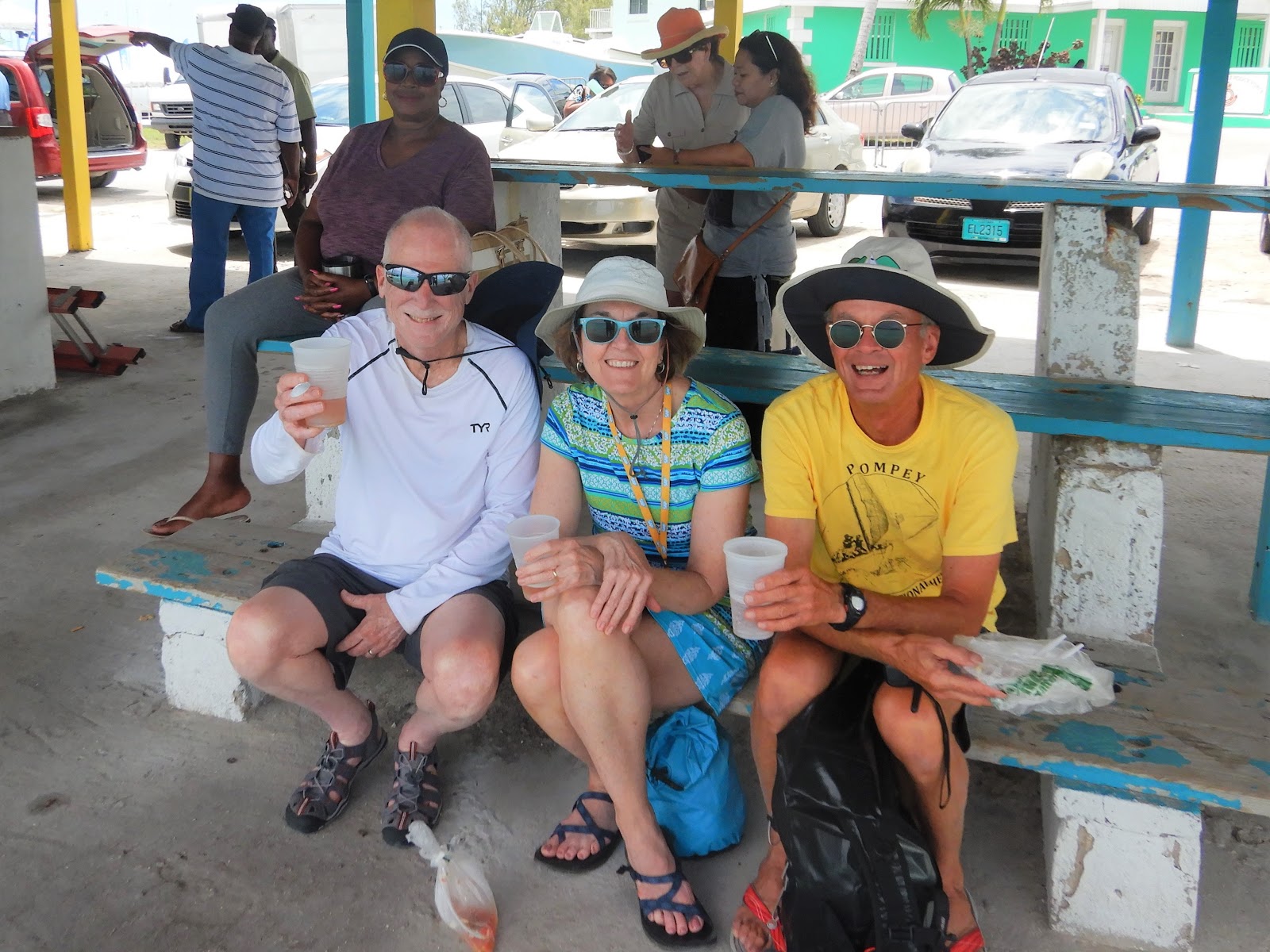
James and Sandra Little flew down to George Town in the Exumas to join us and to watch the 66th National Family Island Regatta.  We are just sitting in the stands between races enjoying a beer.

This is the Bahamian sloop New Legend sailing by behind our anchored boat.  You can see how much sail these boats carry.  To keep the boat upright, the crew must crawl out on two pries hanging out over the water.

As the day ends one last boat sails out into the sun.

On the last day of the regatta the Royal Bahamas Police Force Band put on their show.  They are something to see in tropical uniforms and leopard skin tunics.


There is as much to see below the water in the Bahamas as above.  It is hard to believe, but all three of the creatures are animals.

Last year the children and grandchildren spent a week with us in the Black Point settlement.  Well, this is the nearby White Point.  No one lives here.  It is just white sand beaches.

Sailing from Eleuthera to the Abacos we had two cruise ships pass just ahead of us.  Cruise ships are ugly, and the paint job does not improve things.  See what I mean?


Hello from Brunswick, Georgia.  It has been a very long time since I have written.  I am afraid I have not been a good correspondent on this trip, but I did not want to be too much of a whiner.

When I last left you, we were waiting for a visit from our friends James and Sandra Little.  They flew in a couple of days before the Family Islands Regatta began giving us time to check out George Town, walk on the Stocking Island beaches, and enjoy a few restaurant meals.  Mostly, we just hung out on Irish Eyes.  Once the races started, we managed to anchor in absolutely the best possible spot.  We were just off Volleyball Beach at the Chat N Chill restaurant with the race’s upwind turning mark off our stern.  When the race committee occasionally moved the mark away from us, it was still close enough to set down our drinks and run over in the dinghy for a closer view every time the fleet approached.  One time from aboard our boat, we could hear the calls of “starboard, starboard” before the loud crash of a collision between three racing boats just behind us.

For variety, we also took the dinghy to both the starting line and the finish line.  While most sailboat races start with the boats already underway, Bahamian races start with the boats anchored in a line.  When the starting gun is fired, all the boats pull up their anchor and raise their sails to get underway.  There are lots of opportunities for things to go wrong, sometimes dreadfully wrong.  We took the dinghy to the starting line for one of the races.  There was a crowd of dinghies and motorboats milling around behind the starting line, and we were about the smallest.  Feeling like a chihuahua among great danes and finding our position a little dangerous, we went back to Irish Eyes after the start to watch the rest of that day’s race.  Our venture to the finish line was a little more civilized, mostly because as each boat finished the crowd of spectators shrunk.  We watched each boat cross the line, we heard their supporters whoop and holler, and we saw them all take off to town to party.  We followed later.

The Regatta went from Wednesday to Saturday.  The final entertainment on Saturday evening was a parade by the Royal Bahamas Police Force Band.  We went into town to watch the parade, to have supper at one of the many temporary shacks selling food and booze, and to watch the closing ceremonies.

The band put on a great performance.  Sandra is a good photographer and got some wonderful pictures.  Supper was grilled chicken and pork eaten while sitting on the harbor wall.  The closing ceremony and awarding of prizes began just after we finished our supper.  Almost every government official in the Bahamas was there.  The Prime Minister was in the crowd, his deputy and the Governor General were on stage surrounded by a covey of departmental ministers, district governors, local council leaders, and prominent citizens.  Unlike the U.S., there was no security in sight.  The political speeches were, as usual, too long, but we liked watching the slightly intoxicated and delightfully happy winners collect their fabulous trophies.

The weather while the Littles were with us was great until their last full day when it got progressively cloudy.  We walked to the top of the Monument Hill on Stocking Island and along the beach on the Exuma Sound side of the island.  A couple we first met years ago had said that a snorkel along the rock wall at Monument Beach was not to be missed, so we went.  I’d describe it, but Gayle does a much better job on her web site, http://cruisingbiologists.com/monument-wall-george-town/ .  At 1:30 in the morning the long-awaited thunderstorm arrived (They invariably come when we would rather be sleeping.), and Bill caught enough rainwater to fill our tanks.  Monday morning, we motored across the harbor in the rain, then Bill ferried James and Sandra to shore to meet their taxi to the airport and begin their journey back to Kingsport.

While James and Sandra were with us, we had been monitoring the leak from the transmission.  It seemed to have stopped after Bill’s Loctite and silicone caulking fix.  Bill did notice a small diesel fuel leak from the engine, but it was minor.

We hung around George Town for a week in lousy weather, ready to leave.  There were rumors on Facebook and cautions on the morning radio net about the quality of the diesel fuel at the Shell service station.  While we had enough fuel to get to Staniel Cay, we wanted more in case they were sold out.  Bill took our three 5 gallon diesel jugs into town to buy fuel from the Esso dock (Yeah, it is still Esso there.), but they had none.  The Shell station said their fuel was fine, so he bought 15 gallons.  Back at the boat after adding the first 5 gallons to our tank, he found water in the bottom of the jug.  He added the other 10 gallons doing his best to leave the water behind.  We then circulated our fuel from the tank, through our Racor Aqua-Block filter, and back to the tank for 6 hours to remove the water.  All told we recovered about 3 ounces.  Bill added to our fuel tank a double dose of Biobor JF (a biocide) and another double dose of some $20/quart snake oil stuff he had bought that claimed to clean injectors, increase fuel lubricity, remove water, and dozens of other good sounding things.  It couldn't hurt, could it?  We planned to go north along a shorter route than usual because with our transmission problems we did not want to get too far from the Yanmar dealers in Nassau, Spanish Wells, and Marsh Harbour.  On Friday May 3 the weather cleared, and we sailed north to Galliot Cut and were anchored in time for sundowners.

Our next stop was a Big Farmers Cay.  In past years we had walked along the beaches and explored both a small creek and large cave.  This year, just above the high tide line, were four large “No Trespassing” signs and the creek entrance had been filled with sand.  The creek was interesting because the changes seemed natural, but the signs make us wonder what was happening on this island that was mostly populated by goats.

Farther north, we stopped at the south end of Hawksbill Cay.  We had not stopped there this year, and I always enjoy walking around this end of the island.  I spent a long time swimming in the sun warm water where a creek flowed out to the banks and watching a Reddish Egret walking along the rocky shore.  Bill walked across the island and found the largest float he had ever found.  At nearly 3 feet in diameter, he could not get his arms around it to pick it up.  Thankfully, he left it behind for others to enjoy.

Our last night in the Exumas was spent at Ship Channel Cay.  The rocks around our anchorage were described as a good snorkeling spot by Stephen Pavlidis.  He was right.  We saw all kinds of fish and other creatures.  Ship Channel Cay is Powerboat Adventure’s island base.  They bring tourists from Nassau to feed sharks and rays and to have lunch.  We had the fastest internet of our time in the Exumas while we were anchored at Ship Channel Cay.  Several years ago, we met the owner of Powerboat Adventures.  He told us the only way he could keep young staff was to have great internet.  We older cruisers enjoyed it as well.

The next two days were long days for us.  The first day we motor sailed from Ship Channel Cay to Royal Island; an all-day trip.  The second day was equally long as we sailed across the Northwest Providence Channel from Eleuthera to the Abacos.  We were making tracks north.  The first day we played tag with a thunderstorm and got a little wet.  The second day we played tag on the ocean with two cruise ships but managed to not collide with either of them.

Arriving in the Abacos through the Little Harbour Cut at supper time, we anchored behind Lynyard Cay; another island in the Bahamas that has sprouted No Trespassing signs in the last few years.  We could still walk along the nearby beaches but could no longer walk across the island to the ocean side.

Lynyard Cay gave us protection from the east wind, but over the next several days the wind moved first south then west.  We responded by moving to a spot in The Bight of Old Robinson for the south wind then to Snake Cay for the west then north wind.  Snake Cay is at the north end of the East Abaco Creeks National Park, and a cut between Snake Cay and Deep Sea Cay gives water access to a huge and shallow lagoon behind the cays.  The area is entirely undeveloped, and one of our guidebooks said it was great for dinghy exploring.  The current in the cut was very, very strong, but once inside, the lagoon was calm and pretty.  On our way back to Irish Eyes, we stopped at several small beaches just to see what was there.  All we found was plastic trash.  At our last beach, we failed to anchor the dinghy properly.  I looked back and saw it blowing away.  Bill had to run back down the beach then swim a couple of hundred yards to catch up with the dinghy.  It was a touch and go race for a while, but he eventually caught the wayward dinghy.

The weather was not pretty on May 15.  It was cloudy, and it rained off and on.  I baked bread while Bill tried to patch a leak in the floor of our dinghy.  Weeks before in George Town, Bill had given our can of expensive but out-of-date Hypalon glue to another cruiser in exchange for some freshly caught mahi.  That was OK because Bill had purchased a new can in Miami.  Unfortunately, the new can was for a PVC dingy, and our dinghy is Hypalon.  Bill did not realize that the new can was the wrong stuff until we discovered the leak in our dinghy’s inflatable floor.  He kept busy one whole day trying different types of tape and glue to stop our leak.  His fourth attempt produced the final solution -- superglue under a Hypalon fabric patch pressed firmly in place with two c-clamps and two pieces of wood while the glue set.

The wind picked up and become easterly, so we moved a bit north and anchored in a calm spot off Tahiti Beach.  That put us in dinghy range of both White Sound and Hope Town.  One day we had lunch at the Sea Spray Resort in White Sound then walked to a tiny grocery store for orange juice and a tomato.  The next day we went to Hope Town to look around, have lunch, and do a little shopping.  Hope Town now has a swimming pool.  A teacher holding an umbrella over her head for protection from the blazing sun herded her towel carrying charges down the lane from school to pool.  The children would run ahead passing us, the teacher would make them stop for her to catch up, we would pass the children, and the process would repeat.  I enjoyed talking to the kids every time we passed each other.

Remember the fuel leak I mentioned a few paragraphs back and remember the $20/quart snake oil stuff that promised to clean fuel systems?  Well, it apparently cleaned up around our very minor fuel leak and transformed it from something you could only smell into a steady drip, drip, drip from the top of our engine’s high-pressure fuel injection pump.  By the time we realized the seriousness of the situation it was after 4pm on Friday, and the telephone at the Marsh Harbour Boatyard went unanswered.

We needed the engine not only to move the boat but also to charge our batteries and to cool our refrigerator and freezer.  We planned to motor the two hours to Marsh Harbour on Saturday morning soaking up the leaking fuel with paper towels and anchor near the marinas in case we needed to move into a slip for electricity.  When we tried to start the engine, it would not start.  Where the fuel had been leaking out of the running engine, air had leaked in with the engine off.  Bill bled the air out of the fuel pump, and we got going.  We made it to Marsh Harbour completely soaking four paper towels and leaving a puddle of fuel under the engine.  Bill cleaned up the mess, studied our engine’s shop manual, and read things on the internet.  It seemed a copper washer in the discharge check valve of one of the injections pump’s three cylinders had failed.  Sounds easy enough, change the washer.  Bill did not have the washer nor the tools to work on the pump, and the warnings in the shop manual about unskilled work on the pump sounded serious.  Those of you who know Bill well can imagine how frustrating this was for him.  We hung our solar panel over the side of the boat to give it more sun and reduced our engine run time for the fridge to an hour a day even though it meant that our frozen food would thaw.  (We got to eat steak twice.)  We waited for Monday.

Over the weekend we had several people stop to talk to us.  One was a French Canadian who was sailing his boat, Argo IV, by himself.  He had Googled Irish Eyes because he liked the way she looked and apparently found my blog and our position reports.  When he came over in his dinghy, he called us by name and knew all about us.  If the guy had not been so enthusiastic, honest, and nice, he would have been creepy.  Jumping ahead a couple of weeks, while we were sailing about 60 miles off the Florida coast, the Coast guard asked over the VHF radio if anyone has seen Argo IV.  Bill responded and said we had seen him in Marsh Harbour.  The Coast Guard was only interested if we had seen him in the last six hours.  We do not know what had happened.

On Monday morning, Bill called the boatyard and twice left a message for the mechanic to call us back.  We waited all day and never had a return call.  Tuesday morning, Bill walked over to the yard and found that it would take two to three weeks to get the necessary parts to repair our engine.  The mechanic was to be “off island” in three weeks for two weeks.  It looked like we would have to spend six weeks in Marsh Harbour babying the engine enough to keep our food cold and our batteries charged.  I was ready to jump ship and fly home.  Bill made a second trip to the boatyard.  He ordered the parts in case we needed them.  He stopped at the auto parts store and bought a can of spray brake cleaner, a set of small wire brushes, a set of dental picks, and some epoxy glue for metal.

It took two applications of the epoxy, but the leak was reduced from a drip to a seep.  The engine started just fine.  It was time to head north stopping somewhere between Ft Pierce and New Bern depending on how the leak progresses.  The first day we got to Bakers Bay on Great Guana Cay.  The leak was OK.  The second day we got to Allans-Pensacola Cay.  The leak was OK.  The third day we got to Great Sale Cay.  The leak was OK.  Things were looking up.  The weather forecast was good for the next three days as far north as the St Mary’s River entrance at Fernandina Beach Florida.  North of that the wind was to be 25 to 30 knots with the chance of thunderstorms.  We headed for the St Mary’s River 300 nautical miles away.
 
The wind was very fickle.  At times, usually at night, it blew 20 knots.  At other times we did not have any wind at all.  The engine started every time we needed it.  One evening the engine seemed to vibrate more than usual at the start but calmed down as we ran it.  On Wednesday May 29, after about 57 hours underway, we were anchored in Cumberland Sound.  We cleared via an app on my cell phone.  We never spoke to or saw a single human at Customs and Border Protection.

Thursday morning Bill went swimming and replaced all the zincs on the bottom of the boat including the one on the propeller.  That seemed to stop the engine vibration.  We decided to move up the river to the town of St Marys, Georgia to wait for favorable offshore weather farther north.  We enjoyed the little town of St Marys.  We enjoyed the Submarine Museum, the National Park Service Cumberland Island Museum, a bookstore, and the restaurants in town.  All were air conditioned.  Bill walked the 7-mile round trip to Winn-Dixie for groceries and came back dripping sweat.

For a change of scenery we moved to Cumberland Island for a day, then for diesel fuel we motored up to Jekyll Island then Brunswick, and tomorrow (weather permitting) we’ll resume our trip north to New Bern.

Stay safe and well.